29 July 2010

Bottle Bugs

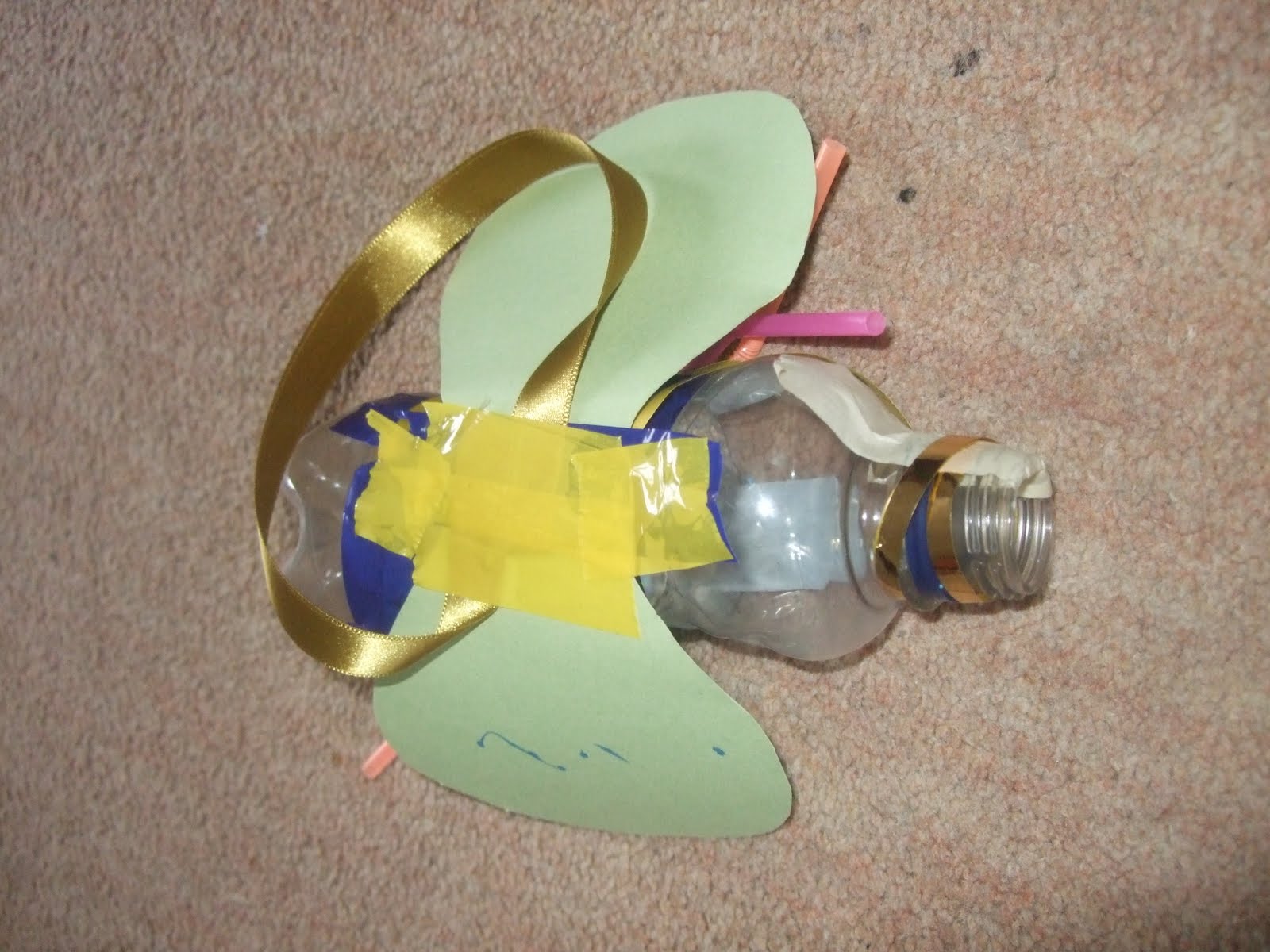
We have been to an art workshop - making minibeasts from plastic bottles... here are our creations:


The six year olds 'bee' all his own design - some help with the sticky tape!


The four year olds 'bee' (copying his brother's - except they ran out of black tape so his has strips of paper coloured black)


The two year old's "bottle-fly"

I am sure that you get the gist... get an empty plastic bottle and decorate it into a bug.

Things you could use:
  • tape (different coloured electical tape works well or masking tape means they can add details using crayons or pens)
  • fabric
  • ribbon
  • paper (tissue paper or cellophane makes good wings, wrapping paper scraps to cover the bottle makes it very colourful, sugar paper makes a good base for butterfly wings)
  • pipecleaners (antennae and legs)
  • straws
  • 'googly' eyes
  • pompoms
  • feathers

Make a real minibeast or an imaginary bug; maybe make lots and host an ugly bug ball or join in the creepy crawly calypso... but most of all have fun.


28 July 2010

Lego Learning

I have three boys (aged six, four and two) so perhaps unsurprisingly we have LOTS of Lego in our house and it is something that they all play together with. Legoland is on their top places to visit and on Monday we had a great day out at the Legoland Discovery Centre in Manchester.

Duplo is a firm favourite for building houses for all sorts of toys, building bridges for the wooden railway and building towers, trains and all sorts of other constructions. Building with Duplo and then standard Lego is great for fine motor skill development as children pick up the pieces and connect them together (tip: pulling apart Duplo is easier than putting it together). We have now started to move onto "little Lego" and are enjoying building models following the instructions.

There are many other targets that can use Lego as a tool...

Colours - match, sort and identify the different colours

Sorting - by colour, shape or size of brick


Patterns - make colour patterns using the blocks (or use them as mosiac tiles)

Shapes - use Lego bricks to build / identify different shapes (both 2D and 3D depending on the bricks you have

Counting - simply use the bricks in place of counters or count how many bricks were needed in your creation. You can also use them for addition and subtraction and solving word problems - make a tower with 3 green bricks and 5 red bricks, how many bricks did you use altogether? or take two blocks away, how many blocks are in your tower now?

Measuring - use your Lego bricks as a unit for measuring (see
No Time for Flashcards for a great demonstration)

Literacy - put words or letters on your Lego bricks to make great literacy manipulatives (see
Filthwizardry for an excellent example)

27 July 2010

The Shape Game

It is a rainy school holiday day - what to do...

Maybe play the shape game? It's a great fun drawing game involving a random shape being transformed into something recognisable, and even the celebs (including Quentin Blake, Emma Thompson, Harry Hill, Ian McEwan and Sir Peter Blake) have been playing it as part of Anthony Browne’s THE SHAPE GAME project, in aid of the charity Rainbow Trust.

They started with this shape drawn by Children’s Laureate Anthony Browne.


and they came up with many different ideas...


Hats proved a common route for many of the contributors involved, with Jo Brand, Axel Scheffler, Jacqueline Wilson, Andrew Motion, Tara Palmer-Tomkinson and Sir Peter Blake amongst those transforming the shape into headwear. Animals were also a popular choice: Harry Hill opting to customise the shape into a whale, Quentin Blake adapting it into a bird and Emma Thompson using her artwork as a way to declare that she is “obsessed with pigs”. Other creations inspired by the animal kingdom include those by Greg Wise (who drew a rhino), Michael Morpurgo (elephant), Michael Foreman (hippo) Catherine Rayner (pig), Linford Christie (bird), Emily Gravett (owl), Shirley Hughes (cat) and Ken Livingstone (shark).

Other creations include a desert island by Booker-Prize winning author Ian McEwan, a person pondering the question: “Why Me?” by philosopher Alain de Botton, and comedian Leigh Francis’s take on 1980s high-school hero, Teen Wolf.

Other contributors to Play the Shape Game include: Anne Fine, Emily Gravett, Meera Syal, Philip Pullman, Tracy Chevalier, Nick Sharratt, Michael Rosen, Imelda Staunton, Anthony Horowitz, Sir Derek Jacobi, Rob Ryan and Jan Pienkowski.

Quentin Blake, the first contributor to sign-up to the project, said:

“I jumped at the chance to get involved; not only was it huge fun thinking about how I’d like to customise Anthony’s shape, but encouraging creativity is something I feel very strongly about. I hope the auction and book go on to raise lots of money for Rainbow Trust, which does such important work to support families at a time of great need.”

Anthony Browne said:

“Although on one level it’s just a game, I believe that it encapsulates the act of creation… everything comes from something else, inspiration is everywhere. I am thrilled that so many big names have joined in to play The Shape Game and I’ve had enormous pleasure looking through their artworks – it’s fascinating to get a glimpse inside the minds of celebrities! Hopefully they will capture the public’s imagination too so that we can raise a good amount for Rainbow Trust.”

Bestselling author Philip Pullman said of his contribution:

“I was enthusiastic about the idea from the start, because I seize on any excuse to get my pencils out, and this idea was so intriguing. I did have to let my mind go free over Anthony’s shape – there’s no point in thinking hard about it, because the exercise really involves thinking very loosely. But as I did, the landscape seemed to form itself around the shape. I loved doing it - huge fun”.

Members of the public will be able to bid for the original artwork from the project at an online auction for further information see
www.childrenslaureate.org.uk. The transformed shapes will also be published by Walker Books in a book, Play the Shape Game, intended to encourage children to use their imaginations. The book, which will be published in paperback at £5.99, will also feature brand new shapes created by the contributors which readers can then customise for themselves.

Both the auction and the book were launched yesterday at a special event at Waterstone’s Piccadilly (London), Europe’s largest bookstore. All funds raised from the auction and all profits from the sales of the book will be donated to Rainbow Trust, a charity which provides vital support to families who have a child with a life threatening or terminal illness.

10 July 2010

Today's Target: Multiplication

Our eldest has just started being interested in learning times tables - he can rote count 2,4,6,8 or 5,10,15,20 or 10,20,30,40,50 etc but now he is beginning to understand the concept behind the counting in 2s, 5s and 10s.


So - 1 x 2 is 2, 2 x 2 is 4, 3 x 2 is 6, 4 x 2 is 8 etc or 2, 4, 6, 8 or some other method? Which is the best way for children to learn their multiplication tables? I think the answer is use as many different methods as possible (and have fun).

Some children will find it really easy to memorise the rote chant of the times tables but it is important to ensure that they understand the underlying maths fact that 4x2 = 2+2+2+2 and that it is the same as 2x4.


Some of the other things we have been doing (apart from the chanting!)
  • pairing socks: counting the pairs / individual socks - a pair = 2 socks, 2 pairs = 4 socks, 3 pairs = 6 socks etc
  • sorting for three children: the number in each bowl x 3 is the number altogether

Please add a comment let us know any ideas you have!


07 July 2010

Today's Target: Colour Matching

Like most other families that live within a 30mile radius of an IKEA store we have these sets of coloured plates, cups, bowls and spoons.

Also (I guess like many other children) our children love to have "matching" sets at each meal time. This causes a bit of angst at the moment as our youngest likes the green set best and our green spoon got lost! However, joking aside, this is a great introduction to colour matching in every day life.

We have also used the bowls as "sorting pots" with other coloured items (for example; coloured paper clips, mini pompoms, crayons, toy cars) matching all the same colour things together in the bowl of that colour.

Learning colour matching is a skill within Mathematical Development - sorting familiar objects to identify their similarities and differences, making choices and justifying decisions and as part of Creative Development as children explore colour.

Other colour matching games that are enjoyed in our house are:


01 July 2010

People Who Help Us: Police Officers

Following my Firefighters post as a continuation of the theme "people who help us" at the Stay and Play group we go to yesterday we had a visit from a police car and a police community support officer.

The children got to climb all over her police van (standing in the "cell" at the back and pretending to drive it), seeing the lights flash, hearing the siren (again a few tears!) and trying on her hat. She also spent time playing with the children to show them that police officers are approachable and people they should go to if they need help.


24 June 2010

People Who Help Us: Firefighters

At the Stay and Play group we go to we currently have the theme "people who help us" and yesterday we had a visit from a fire engine - cue lots of excited toddlers! They got to see the hose and squirt at a plastic traffic cone and hear the siren (a fair few tears!). The fireman talked to the children about who he was, what he did and explained that fire is dangerous and there was lots of literature for parents to take away about fire safety and stickers for the children. Obviously we can't all have a fire engine visit us at home with real firemen to talk to our children but we can encompass the theme of people who help us into our children's play.


22 June 2010

National Breastfeeding Week

This week is National Breastfeeding Week and one of the things that is often talked about when people talk about breastfeeding is that it is no longer seen as "normal" within our culture. Baby dolls are automatically sold with a bottle and a bottle symbol is synonymous with baby facilities - so what about children's literature?

Lots of childrens books - for example the
Usborne First Experiences Series feature the everyday lives of the characters, which is usually similar to the everyday life of young children – they show all the day-to-day things like getting up, having meals, going to school or pre-school, playing, going shopping, going to the park, going to bed etc. All things which will reassure the reader that his or her life is “normal”.

Often in books toddler age children are shown as having a baby brother or sister - how many of these are babies shown breastfeeding? (Answer very few).

When children grow up surrounded by pictures of babies bottle feeding, it can subtly undermine awareness and confidence in breastfeeding, reinforcing bottle feeding as the dominant norm. Given that the current recommendations from the Department of Health and the World Health Organisation are for exclusive breastfeeding to six months and for breastfeeding to ideally continue beyond this to at least two years, surely we should be showing this in the images our children see? The reasons behind this imagery are complex and often it will simply be that it just doesn't occur to the illustrator as breastfeeding is not part of their experience.

One book that does feature breastfeeding is the Usborne First Experiences story:
The New Baby which has an illustration of Mrs Bunn sat in a chair nursing baby Susie - with the text "Mrs. Bunn feeds Susie." and "When Susie is hungry, Mrs. Bunn feeds her with milk. Susie will need to be fed many times each day."


Please add other children's story books that show breastfeeding as normal.

10 June 2010

Today's Target: Letter Formation

Once children are consistently Mark Making it is time to encourage the correct letter formations. There are many resources to help this but ultimately it is practice that makes perfect - the key is to keep the practicing fun.

Our four year old has been product testing the
My First Wipe Clean a-z letters over the half term holiday and has thoroughly enjoyed himself (and yes he is appearing to be left handed).

09 June 2010

Never too late to learn...

I have just been reading this article entitled "I couldn't read or write until I was 27 years old" and it just shows that you are never too old to learn the skills that many of us take for granted. At Littlesheep Learning we sell resources to help children learn to read and write but there is no reason why our educational games couldn't help an adult too - maybe learning in partnership with their child.

If you are an adult who wants to improve your skills try http://www.bbc.co.uk/skillswise/ or http://www.direct.gov.uk/en/EducationAndLearning/AdultLearning/ImprovingYourSkills/index.htm for more information.

08 June 2010

Down's Syndrome - The Essential Guide

We have been sent a copy of Down's Syndrome - The Essential Guide by Antonia Chitty and Victoria Dawson to review. This is the third book in the series that they have written (the first being Special Educational Needs - A Parents Guide).

Down's Syndrome - The Essential Guide is for parents who have just received a diagnosis as well as parents who are already caring for a child with the condition and it covers all aspects of Down's syndrome from diagnosis to adulthood.

In my opinion this book is great, it has simple easy to read chapters so that you can dip in and out as things become relevant to you or read it in one sitting. There are facts, parents experiences and a very comprehensive list of support organisations - a fantastic resource for anyone with a child with Down's Syndrome or who is caring for one.

Published by Need2Know, Down's Syndrome - The Essentual Guide is available now from the Need2Know website (
http://www.need2knowbooks.co.uk/) or by calling 01733 898103 or emailing sales@n2kbooks.com. Price: £8.99.

07 June 2010

Family Time

We have just had half term and part of the reason why this blog has been postless is that we were spending time as a family (trying to create a new play area in the garden!). I was shocked though to read this news article that says that parents spend on average 49 minutes a day together with their children.


Surely that can't be right? If that is an average some people must be spending no time with their children at all?

20 May 2010

New Product: Nursery Rhyme Puppets

We have just taken delivery of this fabulous nursery rhyme finger puppet set at Littlesheep Learning and all three of our children think it looks great - the youngest eagerly pointed out the animals and immediately said "Tinkle Tinkle idle tar", the middle one was pleased he knew all the word and the eldest can manipulate the puppets. We are inclined to agree that it is a great addition to our collection of puppets to support first songs and rhymes.

This six puppet contains finger puppets representing the main characters from each of these popular nursery rhymes: Twinkle Twinkle Little Star, Baa Baa Black Sheep, Humpty Dumpty, 1,2,3,4,5 Once I Caught a Fish Alive, Hickory Dickory Dock and Incy Wincy Spider and comes with a detailed song card to help you if you do not know the words!

13 May 2010

Today's Target: Mark Making to Writing

Children learn to write by starting "mark making" these simple marks then develop into something more recognisable as writing, from a very young age they will imitate adults, grasping writing tools and making marks on paper or any other available surface! It is important during this development that they are encouraged, as young writers as it is from this that handwriting grows.

Mark-making can be done with a pencil and paper but the wider the range of textures and media that are used the more fun it is and the more children will practice it.

Some suggestions:
  • Paint using an easel and brushes
  • Chalk on boards
  • Draw in sand (wet or dry) with either a stick or a finger
  • Paint the playground / wall with water and large brushes
  • Draw shapes in the air with a wand
  • Finger paint
  • Dance with a ribbon in your writing hand
  • Draw in cornflour "gloop"
  • Draw in salt
  • Write with pens on a whiteboard
  • Use chunky triangular crayons
  • Use felt tip pens or colouring pencils
  • Draw in mud with sticks
Learning to hold a pencil and make marks that ultimately lead to writing is a complex development. Young children’s scribblings and drawings are their way of communicating and showing observation of their world and as parents and teachers we should encourage, praise and celebrate their achievements.

Examples of development - writing a weather report by my nearly four year old and my nearly six year old boys.


The scribbled circle is the sun, the sideways wavy line is the "s" (followed by another attempt - that looks like a c), then a recogniseable (but formed incorrectly) "u" and a "n".


There is a whole sentence that is recognisable (one reversed letter and the x to cross out a s which was placed without a finger space) plus a recogniseable picture!


08 May 2010

The Best Books?

A list of 70 children's books said to be the best of all-time has been compiled by publisher Puffin to celebrate Puffin's 70th birthday. The Puffin Handbook is available in bookshops and libraries or can be downloaded here.

The guide is packed full of everything you could ever want to know about children's books and reading, including expert advice, exclusive articles, brilliant books for children of all ages and MUCH more.

The classic counting book The Very Hungry Caterpillar tops the list of best bedtime books, with other favourites featured including Meg and Mog, Spot, Charlie and Lola and The Gruffalo.


Do you agree with Puffin? What books would feature in your top 70?

07 May 2010

Goldilocks and the Three Bears

A little while back I answered a tweet on Twitter from @babysigningmum who was looking for some puppets - specifically Goldilocks and the Three Bears and I showed her these ones and promised to order them in as a special for her.


They arrived this week in a lovely big fabric drawstring bag (ideal for a story sack) and I have to say they are FABULOUS and look even better in real life. I am going to be ordering some more - so watch the website's new products page or contact me directly if you want a set!

05 May 2010

Happy Birthday Littlesheep Learning

Today is FIVE years since Littlesheep Learning opened it's virtual doors and started trading. We would like to thank all of our customers over the last five years and everyone who has offered us help and advice on the journey from the days when we had a few product lines and an order a week to the product range and number orders we receive today. I can't beleive how fast the last five years have gone but here's to the next five and beyond!

To celebrate if you visit Littlesheep Learning during May and use the discount code "birthday" you will save 10% - please tell your friends!

Look out for some other special give aways and offers over the course of the month.

28 April 2010

Growing Sunflowers

Spring has sprung this week and today at "Stay and Play" we planted a sunflower seed so I thought I would write a post about the learning opportunities that this provides

This can cover lots of the Early Years Foundation Stage (EYFS) areas of learning - here are the immediate ones to spring to mind:

Knowledge and Understanding of the World - what does the seed / plant need to grow
Communication, Language and Literacy - writing your name on the pot (mark making)
Problem Solving, Reasoning and Numeracy - how tall is your sunflower? how long is it taking to grow?
Physical development - the fine motor skills of filling the flowerpot with compost and then pushing the seed in
Creative development - decorating your pot / drawing the plant at different stages of development

I am sure there are millions more!