23 January 2007

Letter Formations

People are often asking me about how to help their children with their handwriting so I thought I would write a series of posts on that topic.

Firstly I thought we should look at the correct letter formations. Different settings use slightly different standard formation so if your child is attending nursery or school it is worth checking with their teacher or key worker how they are teaching the letter formations.

A sample alphabet with formation arrows is shown here:

This is a cursive formation (in preparation for 'joined up' writing) therefore there are flicks on the letters, these may be omitted by younger children (in particular the ones on the o, the v and the w). Other letters that may often formed differently are f, k, t and y.

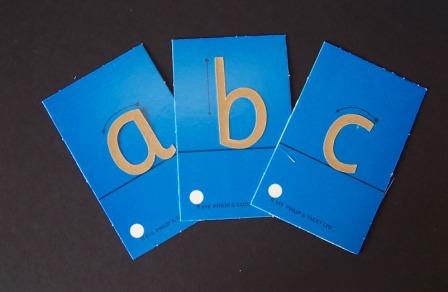
For letter formation teaching aids check out the Rol 'n' Write alphabet and sandpaper letters at Littlesheep Learning.


20 January 2007

Signing

We have just started attending Sing and Sign classes with our second son and the DVD that we were given when our first son was smaller has been dug out - having just watched the Sing and Sign DVD for what seems like the thousandth time this week I thought I would write about signing.

My first experience of signing was when I learnt the finger spelling alphabet when I was about six, I then learnt a few songs with sign during my time at Brownies and Guides but that was all just for fun rather than specifically about communicating. I then learnt more about using sign to support the spoken word when working on abstract concepts with a child with autism - the theory being that as he was a visual learner giving him the sign whilst giving the receptive instruction would make it more concrete.

In January 2005 I did a two day Makaton course and learnt a lot more signs, and a lot more of the research / theory behind signing. My new enthusiasm for sign supported speech led me to investigate baby signing (hence the DVD as my 'baby' was too old to start the classes) and we started signing at home. We also used the popular Makaton based children's television programme Something Special on CBeebies with Justin and Mr Tumble to increase our signing reportoire.

Baby Signing
As a part of typical child development babies naturally use gestures and sounds before speech is well established to help their parents understand them, for example they point, clap. shake their heads and wave. Baby signing involves introducing extra gestures to help your baby communicate. It's easy to do first signs often include milk, more, change nappy, and tired plus favourite animals and vehicles. Sing and Sign classes are one of a number of baby music classes that involve a mixture of teaching parents signs and music activities to entertain the babies.


Sign Supported English
Signed English (including systems such as Signalong and Makaton) have been developed for the same reason as the now popular mainstream baby signing - to assist those with speech and communication difficulties to communicate their needs alongside developing their speech. Signalong and Makaton were developed using British Sign Language (BSL) signs matched to the key words in a sentence, so that as you speak you sign and speak at the same time. Signs are often pictorial and convey the meaning more easily than words, which are more abstract.

For More Information
Makaton
Signalong
Sing and Sign
Chelltune’s Baby Sign Language Store- Books, DVDs, interactive ebooks, keepsake charts, etc for signing babies and children.

18 January 2007

Every Disabled Child Matters

I've just had an email from the Every Disabled Child Matters campaign group updating me about the progress of The Disabled Children (Family Support) Bill.

This Bill will have its second reading in Parliament on Friday 23rd February and this debate is crucial to the chances of the Bill becoming law. All the information about the Bill can be found
here. It is important to get as many MPs as possible to support the Bill and to commit to turning up to the debate on 23rd February. Thanks to people like you and me contacting our MPs, pledges of support for the Bill from MPs are starting to come in, and the campaign now has 230 MP supporters. If you haven't yet contacted your MP you can contact them here. If you have already contacted your MP pass on this information to get as many MPs as possible to support it.

Finally the Every Disabled Child Matters group have set themselves a new supporter target of 25,000 supporters by July 2007. This is the reporting date for the comprehensive spending review, which we hope will bring new money for disabled children's services. To help them reach our new supporter target, please continue spread the word about
Every Disabled Child Matters.

17 January 2007

Make Chatter Happen

My friend's nursery are joining in the Chatterbox Challenge and I thought it would be worth mentioning here in case anyone reading wanted to join in!

The Chatterbox Challenge calls on children across the UK to practise and perform a rhyme or an action song to raise vital funds for I CAN , the charity that helps children communicate. Our 2007 Challenge has a jungle theme so your cheeky monkeys will have fun practising jungle jingles, roaring like lions and hissing like snakes!

Sing and perform your favourite songs and rhymes and join thousands of children across the UK to raise money for children with a communication disability. It's easy to join in, our free activity pack will give you everything you need, including sponsor forms, songs sheets, stickers and colour in certificates for all the children taking part. Register
online today to receive your FREE activity pack.

I CAN is the children’s communication charity, they work to foster the development of speech, language and communication skills in all children with a special focus on those who find this hard - children with a communication disability.

For more information visit:


I CAN

16 January 2007

Glue Ear

Introduction
We've recently been undergoing hospital appointments for our eldest son due to a long term ear infection. At our last appointment we were told he had "glue ear" so I thought as this is the most common cause of hearing loss in children some information may be useful. Glue ear affects about 4 in 5 children have had glue ear at some point by the time they are four years old and that glue ear remains common among children up to the age of six years old and it causes long-lasting hearing problems in about 1 in 20 five year olds.

What is Glue Ear?
The ear is divided into three parts - the outer, middle, and inner ear. The middle ear behind the eardrum is normally filled with air. The middle ear is connected to the back of the nose by a thin channel, the Eustachian tube. Glue ear is a condition where the middle ear becomes filled with fluid that looks like glue instead of draining away down the Eustacian tube - it can affect one or both ears. The fluid dampens the vibrations of the eardrum and bones (ossicles) made by the sound waves, the cochlea receives dampened vibrations, and so the 'volume' of the hearing is 'turned down'.

What are the Symptoms of Glue Ear?
Dulled hearing is the main symptom of glue ear. The hearing does not go completely and the loss can vary from mild to severe, and can vary from day to day. Pain is not usually a main symptom, but ear ache may occur from time to time as the gluey substance is a good food for bacteria, and ear infections are more common in children with glue ear. Delopment and behaviour may be affected in a small number of children.

Teaching Children with Glue Ear
First off if you are a teacher / teaching assistant you may be the one who spots a child with hearing difficulty. Children with glue ear can experience different levels of hearing loss from day to day even from lesson to lesson, so it is sometimes tricky to notice.

Common signs are:

  • inattention - seeming to hear only what they want to hear
  • talking too loudly
  • being quiet and spending time in a world of their own
  • needing to turn up the volume control on PCs and televisions
  • saying pardon or what? more than usual or needing instructions repeated
  • copying their friends actions
  • reacting less to noises and instructions especially from behind them
  • complaining of ear ache and not feeling well
  • mispronunciation of some sounds or words
  • getting very tired during the day as having to concentrate very hard to hear people uses up a lot of energy
For children identified with hearing impairment the following ideas will help them listen:
  • ensure they have the best seating position (e g. away background noise where possible.)
  • make sure that they can see your face (many children quickly learn to lip read and read facial expressions)
  • attract the childs attention by saying their name before asking a question or giving a instruction
  • be prepared to repeat points
  • when talking to the child speak clearly using a normal voice at normal speed but use gesture / signs to reinforce what you say and keep instructions short
  • if appropriate provide a list of vocabulary, context and visual clues especially for new subjects
  • during class discussion allow one pupil to speak at a time and indicate where the speaker is - allow the child to turn around to see other children when they are talking
  • be aware that difficulty with spelling / phonics can result from hearing loss
Further Information
For more information contact:

Royal National Institute for the Deaf (RNID)


The National Deaf Children's Society

09 January 2007

What's planned for this blog

As hinted below on my New Year post I am planning to get cracking with this blog and make it a much more useful and exciting resource - there are lots of things I need to learn as part of this but for the time being I'm just going to focus on writing more!

Teaching Emotions

I've just been sent this link, it's about a small project that used cartoons narrated by the actor Stephen Fry to help teach children with autism about facial expressions and emotions. The research is promising and having viewed the sample episode online I can see how it would particularly appeal to some of the vehicular obsessed children I've worked with. The series was commissioned by the Department of Culture, Media and Sport, and are now being given to around 30,000 other families with autistic children between the ages of two and eight. For more information and to get your free copy look at The Transporters. Let me know what you think and if it helps your child by adding your comments below.

Whilst reading that article I remembered some of the other resources I've used with children with autism to look at emotions so I thought I'd post them here...

Thomas the Tank Engine books are great as the trains faces are used to show the expression and the stories can be used to explain why the character feels as they do. How do you feel, Thomas? is a specific emotions book with the royalties being donated to The National Autistic Society. The new Underground Ernie trains might also give another opportunity for studying faces. Pingu cartoon are good too as the lack of language in them means that children need to infer the feelings of the characters from their intonation, volume and their facial expressions / non-verbal communication.

Another fun ways to look at emotions are acting out scenarios using puppets, this helps to cement how people feel in situations - a good activity is making puppets with different facial expressions using wooden spoons.

02 January 2007

January Sales!


Our January Sales are now on at Littlesheep Learning.

Check out our fantastic savings of up to 50% but hurry as all offers are limited by the stock availability.

Competition Winners

Thank you to all the children who entered our Decorate a Christmas Tree competition, we received some lovely trees and it was very hard to judge the winners.

We are pleased to announce that the winners are:

Eloise from Bolton and Kate from Milton Keynes

Look out for further competitions at Littlesheep Learning later in the year.

Happy New Year

Happy New Year to all our readers - I hope that 2007 will be a successful year for you all.

I've made some New Year Resolutions for both this blog and for Littlesheep Learning so watch out for what's new! I've got lots of educational and teaching ideas to post - let me know your favourite teaching and learning ideas, your top tips for keeping your children enjoying learning or about their favourite toys.

07 December 2006

More Orchard Toys Games in Stock


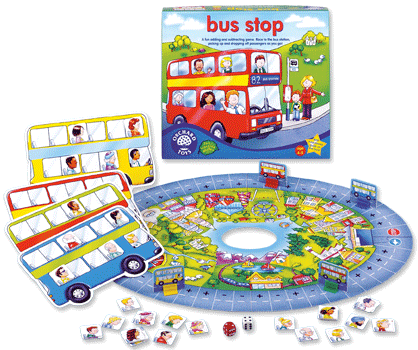
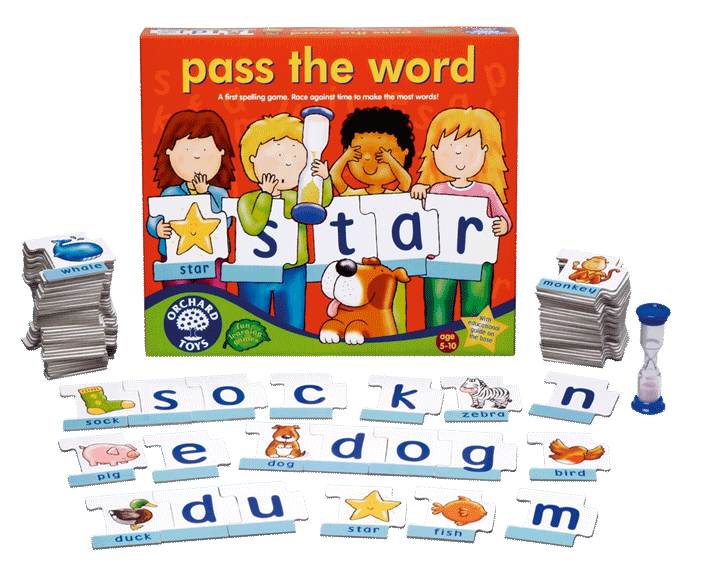
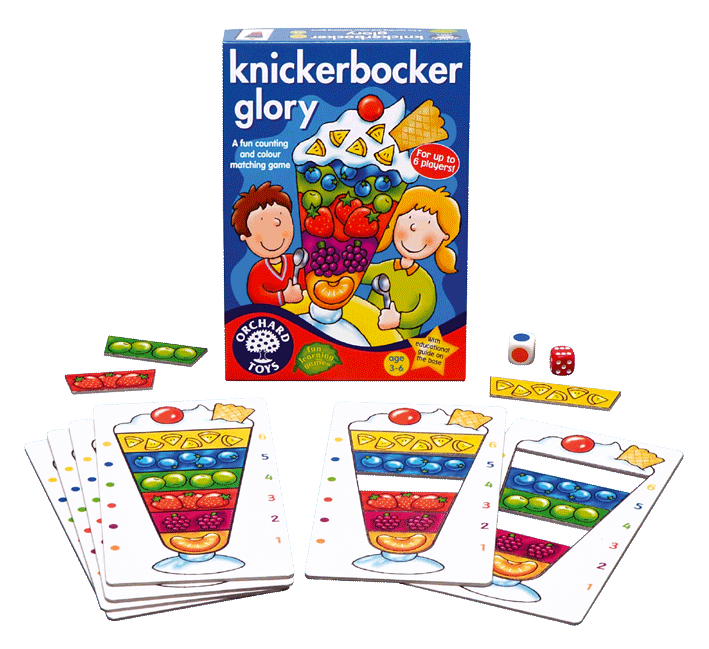
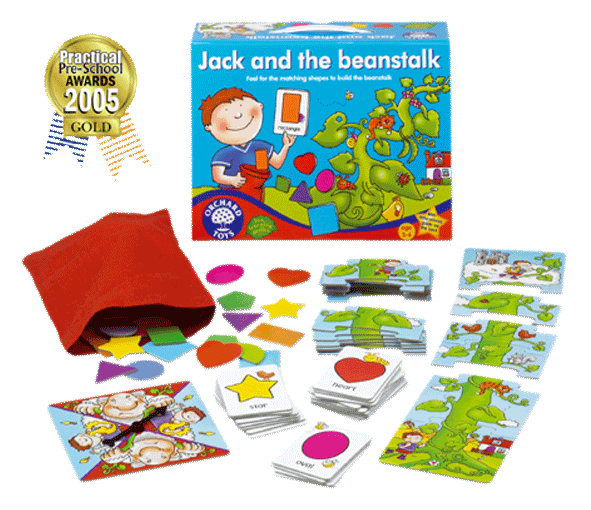
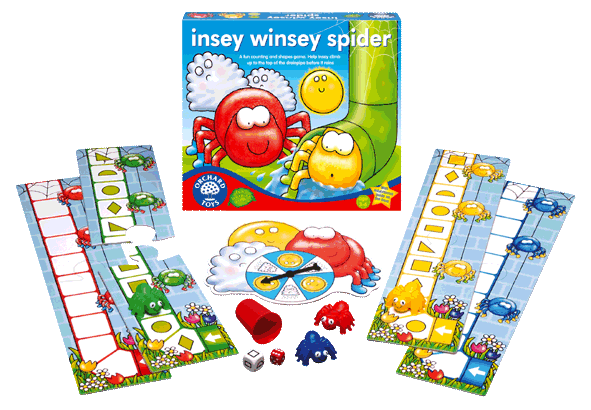
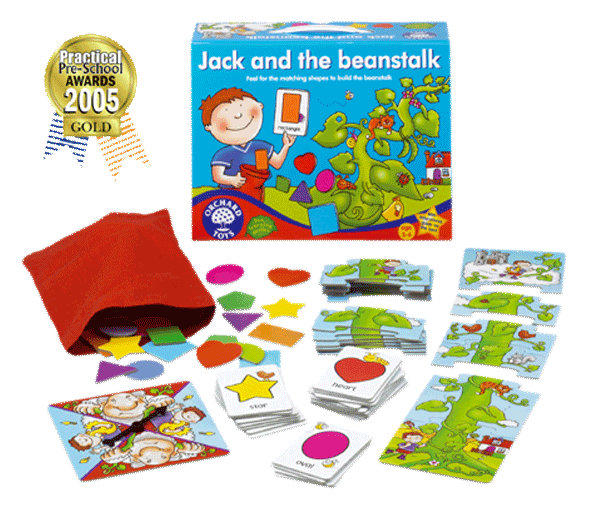
Bus stop, Insey Winsey Spider, Pass the Word, Knickerbocker Glory and Jack and the Beanstalk are now all available at Littlesheep Learning

FREE Downloadable Christmas Colouring and Activity Sheets

We now have a range of FREE downloadable Christmas Colouring and Activity Sheets available on our Resources pages. These have been hugely popular already and we have received several emails saying how much that they have been enjoyed, including:

"Thanks, the colouring sheets kept my 2 busy for a good hour yesterday"

Go and take a look and add your comments about them here.

04 December 2006

Newsletter


Did you receive our December Newsletter? If not you can read it
here - don't forget to sign up to receive our next copy so you are the first to hear our January news.

If you did receive it you were entered into a free prize draw to win a copy of "The Big Book of Things to Do" and we are pleased to announce the winner is:

Karen in Chester

Your prize will be in the post shortly - we hope you enjoy it!
Don't forget to get your children to enter our Christmas Colouring Competition.

Christmas Competition 2006


Download our Tree decorating sheet and send us your decorated trees – prizes for the best tree in the under 5’s and for the 5-12’s age groups. Hurry we need your trees back by 20th December 2006.

New Products - Added this month

Over the last month we've added lots of new products - here's a summary for you.

Sequencing Cards - These are ideal for helping to develop sequencing and language skills. This set contains card sequences including getting dressed, having a biscuit and splashing in a puddle.

Place Value Arrows – As used in schools these are a brilliant way to help children understand hundreds, tens and units.

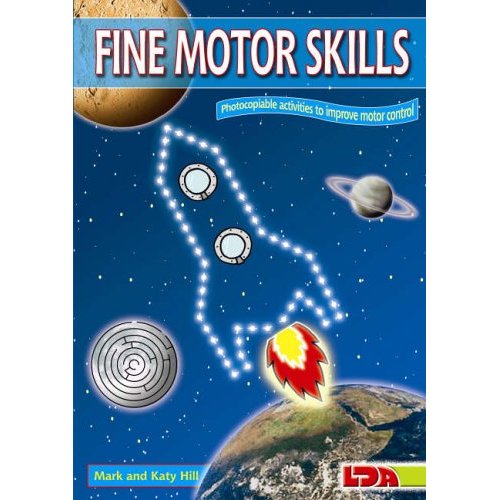
Fine Motor Skills Book - A fully photocopiable book containing activities designed to improve children's fine motor skills, a perfect partner to our best selling Cutting Skills Book.

Tally Counter – Another small item requested by a customer, this handheld tally counter is ideal for counting behaviours or requests or anything really!

27 November 2006

Competition

Subscribe to our newsletter by Friday 1st December 2006 and you will be entered into our FREE prize draw.

Also look out for our decorate a tree competition coming soon.

09 November 2006

Sale!


Remember we still have a few items left in our clearance sale

And for this week only... the
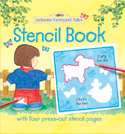
Farmyard Tales Stencil Book is HALF PRICE (whilst stocks last)

Sandpaper Letters and Dice!

I've added two new products today...

One big...
Sandpaper Letters
These sandpaper letters are great for sensory learning... I will be stocking capital letters and numbers soon so you can add to the collection if this method works for your child.

And one small...
Dice
I've started selling dice as requested by a customer (see suggest something and I'll probably stock it!), she was looking for a dice to play a game with her daughter where they threw a dice and then counted the same number of conkers - a great fun activity for learning counting / number to quantity skills.

02 November 2006

November 2006

Are you ready for Christmas? Our CLEARANCE sale has lots of products that would make ideal presents with savings of up to 50% off.

Coming Soon is our first ever Newsletter, create an
account here to receive it - it will contain news, information and special discount codes! Everyone who is registered to receive the newsletter on 1st December 2006 will be entered into a FREE prize draw so make sure you are on the list!

03 October 2006

October 2006

The one problem with owning a retail business is that Christmas has to start early and Littlesheep Learning is no exception. We have now added Christmas stock to our Seasonal category, including our very own Littlesheep Learning Resources Christmas Flashcards.

We also have added more items to our
Clearance sale so take a look for new bargains.